
Elegant Natural Stone Wall for Garden Designs
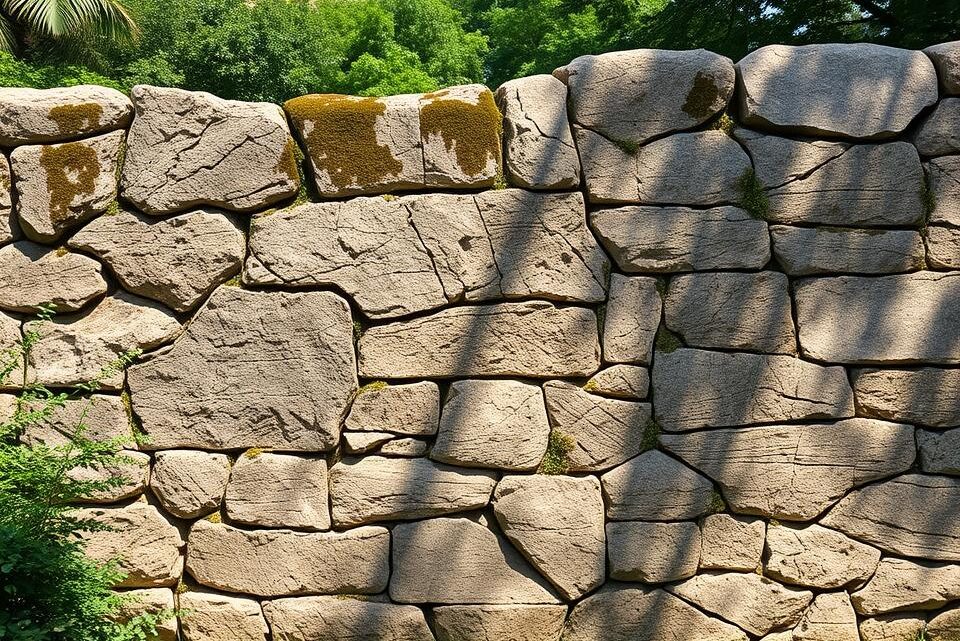
A natural stone wall for the garden can transform outdoor spaces across the United Kingdom. Built from quarried materials such as sandstone, limestone, granite and slate, these structures serve as boundary walls, terraces, raised beds, retaining features or decorative elements that anchor a planting scheme.
This opening section outlines why an elegant garden wall is a popular choice for homeowners, landscapers and garden designers. It highlights key advantages to be explored in the article: improved visual appeal, potential uplift to property value, long-term durability, low maintenance and environmental considerations that suit the UK climate.
The practical value of a garden stone wall design is especially clear in common British contexts. Whether in a compact urban courtyard, a suburban back garden, a sloping site needing terracing, a country estate or a cottage garden, well-chosen garden landscaping stone provides structure and character while coping with wet winters and frost cycles.
Readers can expect a concise guide covering stone types, design styles, siting ideas, construction methods, costs, planting integration and maintenance. The tone is professional and practical, with actionable detail and reference to relevant best practices, including foundations, drainage and party wall or local planning considerations where applicable.
Inhaltsverzeichnis
Key Takeaways
- Natural stone walls combine aesthetics and function for varied UK garden settings.
- Sandstone, limestone, granite and slate each offer distinct looks and performance.
- Good design and proper drainage are essential for longevity in British weather.
- Stone walls can increase property appeal and support terraces, raised beds and seating.
- The article will cover costs, construction methods and planting to inform decision-making.
Benefits of Installing a Natural Stone Wall in the Garden
Natural stone walls bring lasting charm and practical benefits to UK gardens. They lift kerb appeal, create clear boundaries and set a backdrop for planting. Careful selection and siting link the wall to the property, helping planning compliance for period homes and boosting property value landscaping.
Enhancing aesthetic appeal and property value
Stone gives a tactile, timeless finish that buyers notice. Cottage gardens with dry-stone walls, or modern homes with stacked stone, show how style choice complements architecture. Reinstating a Cotswold stone boundary or using reclaimed Yorkshire stone sustains local character while supporting property value landscaping.
Durability and low maintenance advantages
Stone resists rot and insect attack better than timber. Well-built walls endure for decades and often centuries, making them a long-term asset. Routine tasks are simple: clearing vegetation, occasional mortar repair and pressure-washing where needed; this makes a low maintenance garden wall an economical option for busy homeowners.
Freeze–thaw cycles matter in British winters. Good foundations and drainage reduce frost damage and limit costly repairs. Choosing the right stone and construction method improves resilience and keeps maintenance minimal.
Environmental and sustainability considerations
Durability lowers lifecycle impacts because replacements are rare. Local sourcing cuts transport emissions and reclaimed stone from salvage yards reduces demand on quarries. Using responsible suppliers and certified quarries helps manage embodied energy and quarrying impacts, reinforcing the case for sustainable garden materials.
Stone walls also support biodiversity. Crevices offer microhabitats for invertebrates, lichens and small mammals, especially in dry-stone builds. Thoughtful use of sustainable garden materials can marry ecology with design.
| Benefit | Practical effect | Example |
|---|---|---|
| Visual appeal | Improves kerb appeal and aesthetic cohesion | Cotswold stone boundary around a period cottage |
| Longevity | Decades to centuries of service with minor upkeep | Victorian dry-stone terraces in northern England |
| Low maintenance | Simple cleaning and occasional joint repair | Stacked stone retaining beds in suburban gardens |
| Sustainability | Lower lifecycle impact when locally or reclaimed sourced | Reclaimed Yorkshire stone from demolition yards |
| Biodiversity | Microhabitats for insects, lichens and small fauna | Dry-stone wall margins supporting amphibians |
Types of Natural Stone for Garden Walls
Choosing the right stone affects look, durability and cost. Below is a concise guide to common options in the UK and where each works best in gardens.
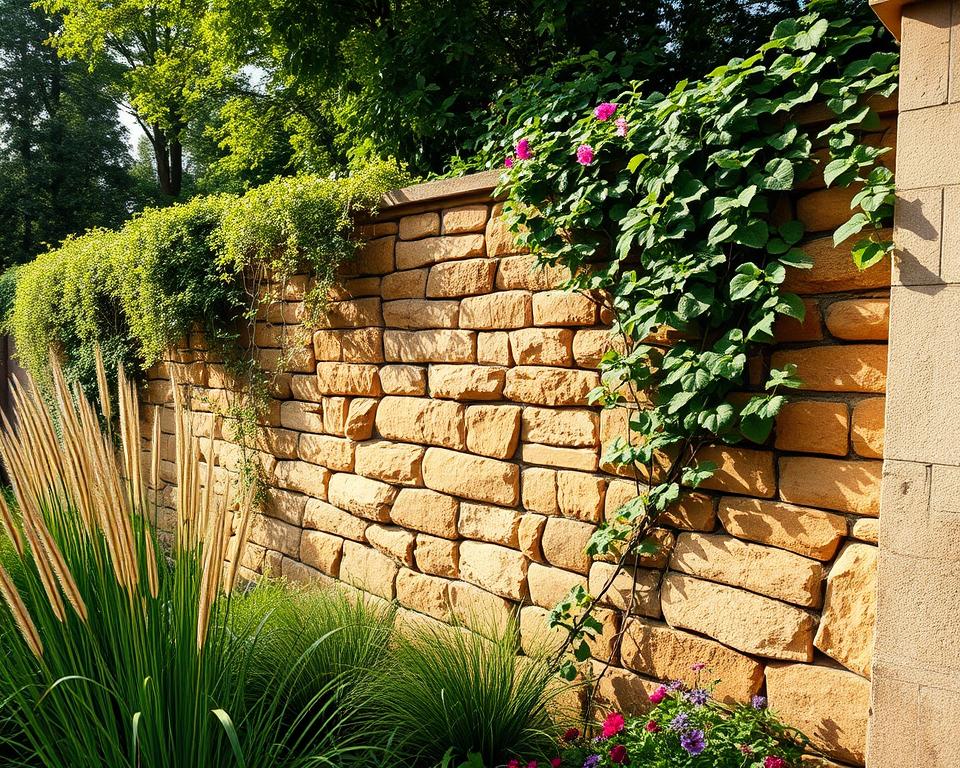
Sandstone brings warm buff, honey, red and grey tones. Yorkshire and Pennine varieties are popular for facing, terraces and boundary work. It is usually easy to dress and cut, so it suits coursed and random rubble styles. Porosity varies, so some pieces need mortar and sealing for exposed locations. A sandstone garden wall pairs well with planting and brickwork and offers a softer, traditional palette.
Limestone ranges from pale cream to warm grey and offers a fine texture. Bath stone, Portland and Purbeck are widely used for copings, dressings and formal garden features. You can hone, chisel or leave limestone rough for different effects. Pay attention to exposure, drainage and the intended use, because some limestones are sensitive to acid rain and salt crystallisation. Choose a suitable limestone wall finish when considering load-bearing or retaining applications.
Granite and slate show a clear split in strength and texture. Granite is very hard and dense, found in grey, pink and speckled tones. It suits heavy-duty work such as structural retaining walls and high-traffic steps.
Slate gives a foliated, fine-grained surface in dark greys, blues and purples. It cleaves into thin sheets that work well for cladding and crisp stacked designs. When weighing granite vs slate wall choices, consider dressing difficulty, compressive strength and the visual effect you want.
| Stone | Colour / Texture | Best Uses | Notes |
|---|---|---|---|
| Sandstone | Buff, honey, red, grey; variable porosity | Decorative facing, terraces, boundary walls | Easy to cut; may need sealing in wet sites |
| Limestone | Pale cream to warm grey; fine texture | Copings, dressings, formal garden walls | Attractive weathering; choose finish for exposure |
| Granite | Grey, pink, speckled; very hard | Structural retaining walls, steps, high-wear areas | High compressive strength; heavy, needs strong footings |
| Slate | Dark grey, blue, purple; foliated | Cladding, veneers, contemporary stacked walls | Cleaves thinly for crisp lines; lighter but brittle edges |
For a retaining project, assess weight, drainage and foundation needs before selecting the best stone for retaining wall use. Comparing properties helps you pick materials that meet structural demands and aesthetic aims.
Design Styles for an Elegant Natural Stone Wall
The choice of style shapes how a garden wall looks and how it functions. Traditional, contemporary and mixed-material approaches each bring distinct character. Below are practical design options and key details to guide decisions for British gardens.

Traditional dry-stone walling and rustic charm
Dry-stone walling UK remains a hallmark of the countryside. Builders select and interlock stones without mortar to create a robust, breathable structure. This method gives a rustic stone wall its weathered look while offering excellent drainage and habitats for wildlife.
Designers focus on batter, through-stones and coping to improve stability. Accredited craftsmen from the Dry Stone Walling Association ensure longevity. These walls suit boundaries, terraces and sites where a natural appearance is desired.
Contemporary stacked stone and clean lines
A stacked stone wall design favours neat edges and close joints. Precision cutting, thin bed joints or hidden mortar produce crisp, modern profiles that fit urban and minimalist plots. Slate and sawn sandstone are common choices for a refined finish.
Attention to joint colour, pointing technique and coping keeps the look contemporary. This style works well as a low retaining wall, a raised bed surround or a sleek dividing feature.
Mixed-material designs with timber and planting
Mixed-material garden wall schemes pair stone with timber sleepers, Corten steel accents or gabions to add texture and depth. Timber inserts can double as seating or planters. Corten steel offers a warm, evolving patina beside stone.
Design must allow for differential movement and weathering. Specify correct fixings, damp-proof layers and drainage between materials to avoid long-term issues. Thoughtful planting softens transitions and unifies the combination.
Choosing between a dry-stone approach, a stacked stone wall design or a mixed-material garden wall depends on site conditions, desired look and maintenance expectations. Each option offers a unique way to bring a rustic stone wall or a modern statement into a UK garden.
Natural stone wall for the garden
Thoughtful placement transforms a simple stone wall into a defining garden feature. Use natural stone to mark edges, shape level changes and create planting frames that suit both small urban plots and larger country gardens.

Placement ideas: boundaries, terraces and raised beds
Boundary walls provide privacy and a clear property edge. Before building, check party wall rules and local planning if the wall is shared or rises above permitted heights.
On sloping sites, stone terracing forms durable retaining walls that cut soil erosion and carve flat, usable beds. Include engineered drainage and weep holes so water does not build up behind the wall.
Low walls make neat raised beds. Raised beds stone keeps soil warmer and improves drainage, making them ideal for herbs, vegetables and compact ornamentals. The tidy edges reduce bending when tending plants.
Integrating walls with garden features like steps and seating
Design walls to include practical features such as integrated steps and stone wall seating. Coped ledges and stone benches give a solid, long-lasting place to rest while staying in scale with the garden.
Follow building regulations for riser and tread dimensions where required. Choose a non-slip finish on steps and match materials between paving and walls to maintain a cohesive flow around patios and paths.
Incorporate housings for lighting or small planters into the wall to add function without sacrificing style.
Using walls as a backdrop for planting schemes
Stone walls offer contrast to soft planting. Warm sandstone pairs well with silvery-leaved perennials while darker granite highlights bright herbaceous blooms.
Use crevices and pockets for alpines such as saxifrages and thyme. Train climbers like Clematis or climbing roses on trellis fixed to the wall to add vertical interest and seasonal colour.
South- and west-facing walls create warmer microclimates suitable for Mediterranean species. North-facing aspects favour shade-tolerant plants and encourage moss and lichen to settle, adding texture over time.
| Feature | Best use | Key benefit |
|---|---|---|
| Boundary wall | Privacy and property demarcation | Clear edge definition and security |
| Stone terracing | Sloping sites and level creation | Prevents erosion and creates flat garden areas |
| Raised beds stone | Herb, vegetable and ornamental beds | Improved drainage and ease of maintenance |
| Integrated steps | Transitions between levels | Safe, durable circulation with cohesive material use |
| Stone wall seating | Built-in benches and ledges | Long-lasting seating that complements planting |
| Wall pockets and crevices | Alpines and drought-tolerant plants | Added biodiversity and seasonal interest |
Construction Methods and Best Practices
Good garden wall construction begins with clear site preparation and a plan that matches the wall’s purpose. Think about load, height and ground type before you dig. Early decisions on stone selection and build method will shape foundation depth, drainage and long-term performance.
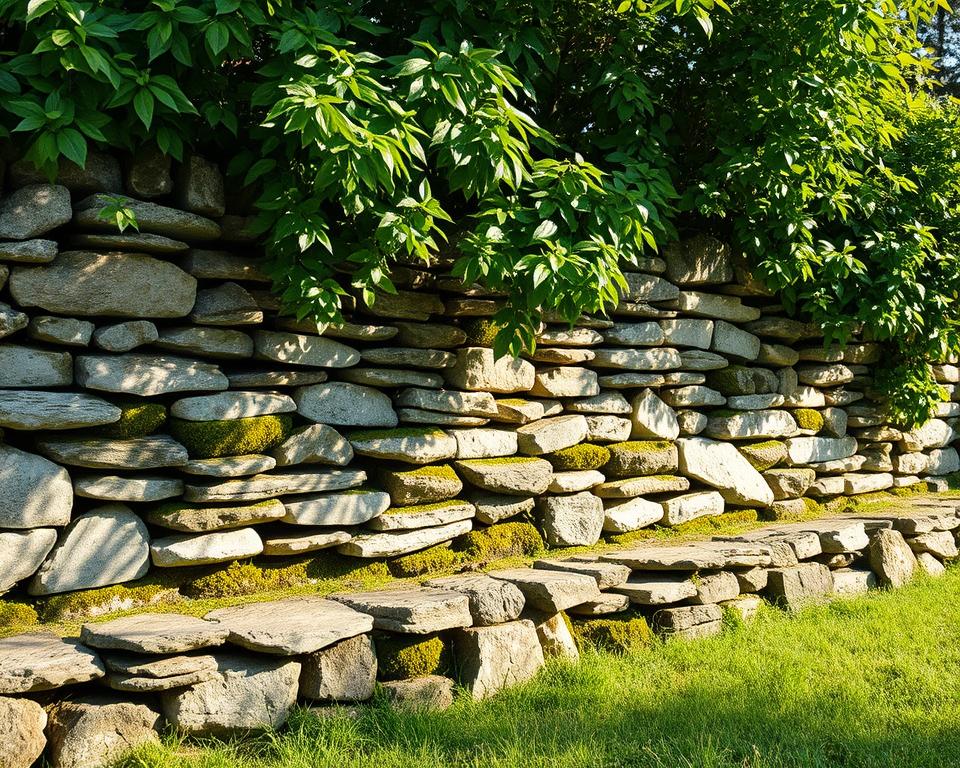
Foundations, drainage and frost protection
A stable base is non-negotiable for lasting stonework. Trench depth and a concrete footing should reflect local soil conditions and the wall height. In the UK, frost depth influences how low foundations must go to avoid frost heave.
Provide reliable wall drainage frost protection by installing gravel backfill and a perforated drain pipe behind retaining walls. Weep holes help release trapped water and reduce hydrostatic pressure on the structure.
Where a wall meets a building, add damp-proof membranes and adequate coping to shed water away from the joint. These measures prevent moisture ingress and prolong the life of mortar and stone.
Dry-stone versus mortar-built techniques
Dry-stone construction offers breathability and flexibility under movement. It suits curved lines and wildlife-friendly gardens. Skilled craft is required to select fitting stones and to create a stable batter. Dry-stone is less suited for very tall retaining walls unless reinforced.
Mortar-built walls give immediate cohesion and can accommodate irregular stone shapes. Good stone wall foundations and control joints reduce cracking when the ground shifts. For higher or load-bearing retaining walls, reinforced solutions such as geogrids or concrete cores may be necessary; consult a structural engineer for those cases.
Hiring professionals versus DIY considerations
Professional stonemasons, accredited dry-stone wallers and landscapers bring training, insurance and local knowledge. Ask for references, certificates and written quotes when comparing contractors. Experts will size foundations, specify wall drainage frost protection and comply with regulations.
DIY garden wall construction can be rewarding for low walls, raised beds and decorative features. Assess your skill level, tools and available time before committing. Essential tools include levels, a masonry saw and a concrete mixer for footings. Check for buried services and obtain any necessary party wall agreements or planning consents prior to excavation.
Cost Considerations and Budgeting
Planning a garden stone wall needs clear figures and sensible allowances. The cost of stone wall varies by material, sourcing and site work. Early estimates help owners weigh reclaimed stone price against quarried alternatives and decide on quality, finish and scale.

Sandstone, limestone and granite sit in different price brackets. Local quarries and reclamation yards such as reclaimed Yorkstone suppliers often offer authentic finishes at competitive rates. Factor delivery for heavy loads, waste allowance, coping, mortar, geotextiles and any reinforcement when you calculate reclaimed stone price into the budget.
Labour and installation:
Skilled trades dominate the spend. Dry-stone walling is labour-intensive and is commonly priced per metre or per square metre. Labour costs stone wall include foundation digging, drainage, scaffolding for taller work and machinery hire such as a mini-digger. Request itemised quotes and include contingency for unexpected ground conditions.
Long-term value and maintenance:
Stone walls often outlast timber and block alternatives, cutting replacement frequency. Budget for periodic pointing, cleaning, re-bedding loose stones and vegetation control. Consider how quality stonework can add resale value, especially in conservation areas and period properties when you finalise stone wall budgeting UK.
Quick comparison:
| Item | Typical range (per m) | Notes |
|---|---|---|
| Reclaimed stone supply | £25–£80 | Varies by availability; reclaimed stone price often lower but check condition |
| Quarried sawn stone | £60–£180 | Premium finish, higher delivery and handling costs |
| Labour (dry-stone) | £120–£300 | Skilled wallers charge more; complex joins increase time |
| Labour (mortar-built) | £90–£220 | Faster in some cases, but requires pointing maintenance |
| Groundworks & drainage | £30–£150 | Depends on depth, access and soil conditions |
| Contingency | 10–20% | Allow for surprises like roots or buried debris |
Use these figures to create a realistic cashflow. Accurate stone wall budgeting UK and clear line items for labour costs stone wall reduce risk and keep the project on track.
Planting and Landscaping Around Stone Walls
Stone walls set a strong visual stage for planting schemes that work with texture, colour and form. Choose plants for stone walls that reflect the wall’s tone: cool grey stone pairs well with blue and silver foliage such as lavender and artemisia. Warm buff or honey-coloured stone finds balance with golden-leaved shrubs and purple blooms.
Match plant size to wall scale. Taller shrubs suit high retaining walls while low perennials and alpines sit well on ledges and crevices. Consider soil depth and drainage when planting against stone; many Mediterranean and alpine species tolerate the free-draining pockets at the wall base.
Creeping and trailing species soften hard edges and add seasonal interest. Use thyme, sedum, dianthus and saxifrages in crevices to provide carpeted colour. Hedera helix can trail attractively but monitor vigour to prevent mortar damage.
For a vertical effect, train climbers on a discrete trellis: Clematis montana and Lonicera periclymenum give strong seasonal display. Climbing roses bring scent and structure but need careful root-zone management when planting against stone.
Design a layered plan for year-round interest. Combine bulbs such as narcissi and crocus with summer perennials, autumn fruiting shrubs and evergreen structure. This approach makes the stone a seasonal planting stone backdrop that changes through the year.
Maintain a simple cycle of deadheading, mulching and light feeding to keep border plants healthy. Regular pruning keeps trailing plants stone wall growth in check and prevents scrimshaw of mortar by vigorous climbers.
Maintenance, Repair and Longevity of Stone Walls
Regular care keeps a stone wall sturdy and attractive for decades. A short annual check, plus inspections after severe weather, helps spot movement, bulging, loose stones and failing drainage before these issues grow worse. Photograph faults with dates to track changes and to show tradespeople the exact problem.
Inspection checklist
- Look for cracked or missing mortar and any displaced stones.
- Check wall tops for plant growth and blocked copings.
- Clear nearby drains and weep holes so water can escape freely.
Repointing and reset works
When mortar fails, repointing stone wall joints with a compatible mix is essential. Use lime mortar on older walls to allow breathability and gentle movement. Seek a stonemason experienced with lime if the wall is historic. For modern builds, match the original mortar strength to avoid damage.
Replacing loose stones may mean dismantling a short section and rebuilding with correct bedding and through-stones. Dry-stone walls need careful stone selection and interlocking to restore stability. For major collapses or tall retaining walls, engage a structural engineer to specify works and ensure safety.
Preventing common problems
- Remove deep-rooted plants and trees near foundations to prevent root-induced movement.
- Fit copings with an overhang and provide drainage behind retaining walls to prevent wall damp.
- Inspect for burrowing animals that could undermine foundations and consult wildlife guidance where protected species are present.
Practical tips for owners
Maintain a clear verge at the base and trim vegetation on the face. Use gentle cleaning to remove moss where it traps moisture. Document repairs and share photos with any contractor asked to repair stone wall sections.
| Task | Frequency | Why it matters | When to call a pro |
|---|---|---|---|
| Visual inspection and photos | Annually and after storms | Early detection of movement or drainage issues | If bulging, large cracks or repeated water pooling |
| Clear vegetation and moss | Seasonally | Reduces trapped moisture that can accelerate decay | If invasive roots reach the foundation |
| Repointing stone wall joints | As needed; typically every 20–40 years | Restores joint integrity and prevents water ingress | Use a stonemason for lime mortar on historic walls |
| Replace loose or fallen stones | As required | Prevents progressive collapse and preserves stability | For long stretches of failure or tall retaining walls |
| Improve drainage and copings | When damp signs appear | Helps to prevent wall damp and frost damage | Consult a structural engineer for failing retaining walls |
Conclusion
Natural stone walls deliver a clear natural stone garden summary: they combine lasting beauty, practical structure and ecological advantages. Choosing between sandstone, limestone, granite or slate affects colour, texture and durability. The right stone and design will set the tone for a garden and add measurable character to a property.
This stone wall benefits summary highlights styles and siting: traditional dry-stone and contemporary stacked walls each offer distinct looks, while mixed-material schemes bring warmth when paired with timber or planting. Consider placement for boundaries, terraces, raised beds and seating so the wall fulfils both aesthetic and functional roles.
Construction matters. Good foundations, proper drainage and frost protection lengthen life, and decisions about mortar versus dry-built techniques influence maintenance. Assess site conditions, local sourcing from quarries or reclamation yards, and whether an accredited stonemason is required for load-bearing or tall walls. Check planning rules and party wall obligations before work begins.
In summary, a garden design stone conclusion is clear: with careful selection, thoughtful design and sound workmanship, a natural stone wall enhances long-term value, supports biodiversity and brings enduring elegance to UK gardens across the seasons.
FAQ
What is a natural stone wall for the garden?
A natural stone wall is a structure built from quarried or reclaimed stone such as sandstone, limestone, granite or slate. It can serve as a boundary, retaining wall, raised bed edge or decorative feature. In UK gardens these walls combine aesthetic appeal with durability and can be constructed as dry-stone or mortar-built depending on style and function.
Which types of stone are best for garden walls in the UK?
Choice depends on appearance, strength and local availability. Sandstone (Yorkstone, Pennine) offers warm tones and is easy to dress. Limestone (Bath, Portland) gives pale, weathering finishes suited to formal styles. Granite is extremely durable for structural uses, while slate works well for thin, stacked or contemporary cladding. Local sourcing and reclaimed stone often suit regional character and reduce embodied carbon.
Should I use dry-stone or mortar-built techniques?
Dry-stone walls provide permeability, wildlife habitat and flexibility and suit traditional, lower-height or character projects. Mortar-built walls give immediate strength and are suitable where irregular stones are used or where a more sealed finish is required. For tall retaining walls or those carrying loads, engineered or reinforced solutions and a structural design are recommended.
What foundation and drainage considerations are necessary?
Adequate foundations sized to soil type and wall height are essential. For retaining walls, include gravel backfill, perforated drainage pipe and weep holes to avoid hydrostatic pressure and frost heave. Use damp-proofing where walls abut buildings and ensure copings shed water to protect mortar and the wall core.
How does the UK climate affect stone wall selection and construction?
Freeze–thaw cycles and wet winters mean drainage and frost protection are critical. Choose stone and mortars that tolerate local exposure—some sandstones and limestones may be more porous. Good backfill, free-draining material and correct coping detail reduce the risk of frost damage and salt crystallisation.
Can a stone wall improve my property’s value?
Yes. Well-executed stonework enhances kerb appeal, complements period architecture and can be a positive feature in valuations—especially in conservation areas or for character properties. Quality materials, sympathetic design and professional installation contribute most to perceived value uplift.
Is reclaimed stone a good option?
Reclaimed stone is often sustainable, authentic and cost-effective. It suits traditional repairs and new builds seeking a vernacular look. Verify structural soundness and sufficient quantity, and source from reputable reclamation yards to ensure consistent colour and dimensions where required.
What maintenance do stone walls need?
Routine inspection is recommended annually and after severe weather. Tasks include clearing vegetation, checking for loose stones, cleaning drainage and repointing where mortar has deteriorated. Use compatible materials—lime mortar for historic walls—to allow movement and breathability. Major structural issues should be assessed by a stonemason or structural engineer.
How do I choose plants to complement a stone wall?
Match plant tones and textures to the stone: cool-grey walls suit silvery foliage and blues (lavender, artemisia), warm buff sandstones pair with golden and purple blooms. Use alpines and creeping species in crevices (thyme, sedum, saxifrages) and select climbers or sheltered microclimate plants on south-facing walls. Consider root impact and avoid vigorous species that may damage mortar.
Can walls include seating, steps or lighting?
Yes. Stone walls can incorporate coped seating, integrated steps and housings for lighting. Design transitions to meet safety and building regulations for riser/tread sizes where relevant, and use non-slip finishes for steps. Coordinate materials to ensure coherent appearance and account for differential movement between materials.
How much does a natural stone garden wall cost?
Costs vary with stone type, sourcing (reclaimed vs sawn), wall height, foundation complexity and labour. Skilled dry-stone walling is labour-intensive and may cost more per metre than simpler mortar-built walls. Include delivery, coping, drainage, geotextiles and contingency for ground conditions when budgeting. Obtain multiple itemised quotes from professional stonemasons or landscapers.
When is professional help required versus DIY?
Hire accredited stonemasons, landscapers or Dry Stone Walling Association members for tall, load-bearing, party or complex retaining walls, and where planning or party wall issues apply. DIY can be viable for low raised beds or small decorative walls if you have basic masonry skills, tools and understand foundations and drainage. Check for buried services before excavation.
Do I need planning permission or party wall agreements?
Smaller garden walls usually fall outside planning control, but height, location and conservation area status can trigger consent. Shared or boundary walls may require a Party Wall Agreement under the Party Wall etc. Act 1996. Consult your local planning authority and seek legal or surveyor advice when a wall affects neighbours or is over permitted heights.
What wildlife benefits do stone walls offer?
Stone walls create microhabitats—crevices for insects, lichen and moss growth and, in dry-stone walls, refuges for small mammals, amphibians and invertebrates. They can enhance biodiversity when combined with sympathetic planting. Be mindful of protected species; if bats or nesting birds are present, follow wildlife guidance before work begins.
How can I ensure longevity of my stone wall?
Use appropriate stone and mortar for exposure, ensure solid foundations and effective drainage, and follow best construction practices. Regular inspections, timely repointing with compatible mortar and control of adjacent vegetation will preserve structural integrity. For critical walls, engage a structural engineer for design and specification.